Blog
How ChatGPT, Perplexity, and Google AI Overviews decide who to recommend
2026-04-22 · by Roger Pemberton
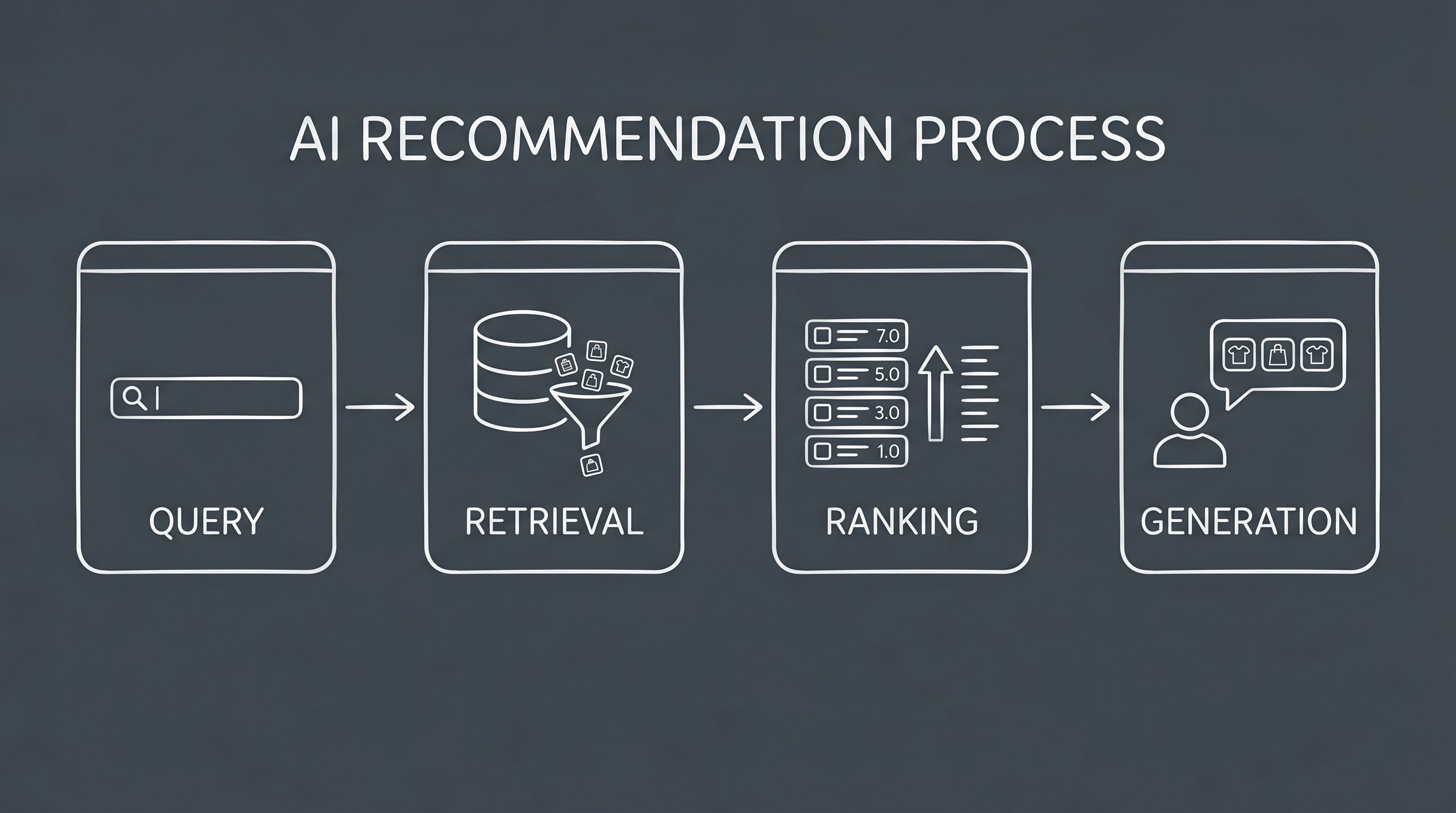
The honest answer: nobody outside OpenAI, Google, Anthropic, and Perplexity knows the exact ranking algorithms. But the observable behavior — what gets cited, what doesn’t — is remarkably consistent across systems. Here’s what we’ve learned from building AEO into dozens of sites.
The general pattern
Most modern AI search systems combine three stages:
-
Retrieval. Given a user’s query, the system fetches a set of candidate documents — pages the model thinks might contain the answer. This uses some combination of vector search, keyword matching, and cached web indexes.
-
Re-ranking. The candidates are re-scored based on relevance, recency, authority, and (for some systems) user-profile signals.
-
Generation and citation. The model writes an answer grounded in the top-ranked documents, and cites them inline.
Your goal, as a business, is to end up in stage 3. That means being retrievable, rankable, and quotable.
What makes a page retrievable
- Clean, crawlable HTML. No critical content behind JavaScript rendering that the crawler can’t see.
- Explicit signals. Schema markup (JSON-LD) tells the system exactly what’s on the page. It increases the chances you’re retrieved for a matching query.
- AI crawler access. GPTBot, ClaudeBot, PerplexityBot, Google-Extended all respect robots.txt. Blocking them — even accidentally — removes you from contention.
- Reasonable performance. Slow pages get deprioritized by most crawlers.
What makes a page rank well once retrieved
- Clear structure. Headings, short paragraphs, clean topic organization. LLMs “read” pages similarly to how strong human readers do.
- Authoritative signals. Backlinks still count. Consistent business information (NAP), accurate contact info, and presence in reliable third-party data sources (Wikipedia, Crunchbase, industry directories) all factor in.
- Freshness. An article with a recent
dateModifiedranks higher on time-sensitive queries. - Topical depth. A site that covers a topic thoroughly across multiple pages outranks a site with a single thin page.
What makes a page quotable
This is the one that most websites miss.
- Short, self-contained definitions. If your page opens with “Local SEO is the practice of…” — that paragraph can be lifted verbatim and cited. Long, adjective-heavy marketing copy cannot.
- FAQ sections with clean Q/A pairs. Each one is a quotable answer to a specific question.
- Lists and tables. Structured content is easier to cite than prose.
- Clear authorship and dates. Models prefer content with named authors and explicit freshness signals.
Pages written for humans but structured for retrieval tend to do well in AI search. Pages written as long marketing brochures tend to be invisible.
The counterintuitive part
SEO has, for years, rewarded long “pillar pages” stuffed with keyword-dense sub-sections. AI Search Optimization inverts some of this: clean short answers near the top, structured FAQs, clear definitions, citations to authoritative sources. The style of writing that ranks well in AI search is closer to a Wikipedia article than a sales page.
This doesn’t mean you abandon sales copy. It means you put the quotable definition first, the structured answers second, and the conversion-focused sales copy below — or on a separate page.
What this means for a small, locally-owned business
- Your Local SEO foundation matters to AI search. Reviews, citations, and GBP completeness all feed authority signals.
- Schema is table stakes. If your site has no FAQPage, Service, or LocalBusiness schema, you’re invisible to most AI retrieval.
- One great Q&A on your site is worth more to AI search than ten paragraphs of branding.
llms.txttells AI crawlers which pages you most want them to index first. Publish one.
The businesses that invest in this now will be the ones AI search systems reach for by default in 2027. The businesses that wait will be wondering where their calls went.
If you’d rather have a senior advisor review your site against these signals and hand you a prioritized plan, that’s what a Digital Presence Audit is for.